Have you ever checked your phone before leaving home to see if it might rain later in the day? Weather forecasts have become a part of our daily routine, helping us plan travel, outdoor activities, work, and special events. But have you ever wondered how meteorologists predict tomorrow's weather?
Modern weather forecasting is a combination of science, technology, and advanced computer modeling. Every day, millions of weather observations are collected from satellites, radar systems, weather stations, ships, aircraft, and balloons around the world. This information is analyzed using powerful computers that estimate how the atmosphere is likely to change over the coming hours and days.
Although no forecast can be 100% perfect, modern forecasting technology has become remarkably accurate, especially for short-term predictions.
What Is Weather Forecasting?
Weather forecasting is the process of predicting future atmospheric conditions for a specific location and time. Meteorologists study current weather conditions and use scientific models to estimate how temperature, rainfall, wind, humidity, and air pressure may change.
Forecasts can range from a few hours to several days ahead. Some organizations also produce long-range outlooks, but these provide general trends rather than exact daily weather.
The primary goal of weather forecasting is to help people stay safe, plan their activities, and prepare for changing weather conditions.
How Weather Data Is Collected
Accurate forecasting begins with collecting large amounts of real-time weather data from many different sources across the world.
Weather Stations
Ground-based weather stations continuously measure important atmospheric conditions such as temperature, humidity, rainfall, air pressure, wind speed, and wind direction. Thousands of these stations operate in cities, villages, airports, farms, mountains, and coastal regions.
Weather Satellites
Weather satellites orbit the Earth and capture images of clouds, storms, oceans, and atmospheric conditions. They help meteorologists monitor developing cyclones, cloud movement, rainfall systems, and large-scale weather patterns over land and sea.
Satellites are especially useful for observing remote areas where ground weather stations are limited.
Weather Radar
Radar systems detect rain, snow, hail, and thunderstorms by sending radio waves into the atmosphere and measuring the signals reflected back by precipitation.
Weather radar allows forecasters to track storm movement, estimate rainfall intensity, and issue timely warnings for severe weather.
Weather Balloons
Special weather balloons are launched every day in many countries. As they rise through the atmosphere, they collect information about temperature, humidity, wind, and pressure at different altitudes.
These observations provide valuable data that cannot be measured from the ground alone.
The Role of Computer Models
Collecting weather data is only the first step. Modern forecasting relies heavily on powerful computer models that simulate how the atmosphere behaves.
These models process millions of observations every day and calculate how weather systems are likely to move over time. They consider factors such as air pressure, wind patterns, temperature changes, moisture levels, and interactions between land, oceans, and the atmosphere.
Because weather is constantly changing, these models are updated several times a day using the latest available observations.
Why Weather Forecasts Sometimes Change
Many people notice that forecasts occasionally change from one day to the next. This happens because the atmosphere is extremely dynamic, and new observations become available every few hours.
As fresh data enters forecasting models, predictions are refined to reflect current conditions more accurately.
Several factors can affect forecast accuracy, including:
- Rapidly developing storms
- Changing wind patterns
- Local geography
- Mountain ranges
- Coastal influences
- Unexpected atmospheric changes
For this reason, forecasts generally become more accurate as the event gets closer.
Forecast Accuracy
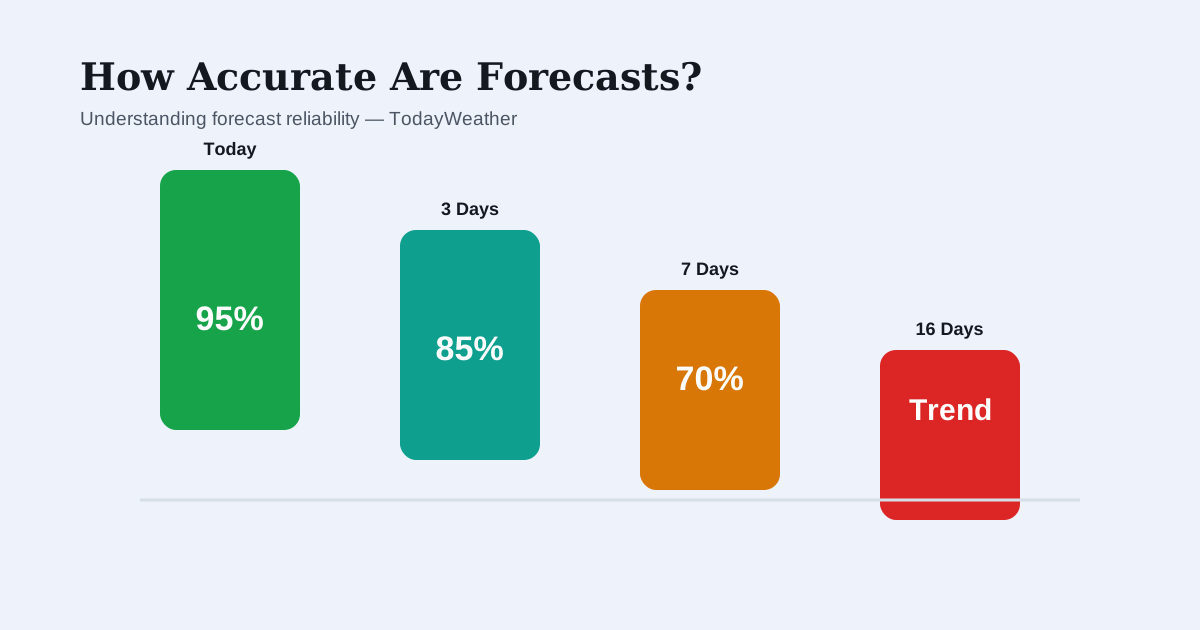
Today's weather forecasting technology is far more advanced than it was decades ago. Short-term forecasts for the next one to three days are generally very reliable in many parts of the world.
Forecast accuracy gradually decreases as the prediction extends further into the future because small atmospheric changes can grow over time.
Meteorologists continuously compare forecast results with real observations to improve future forecasting models and techniques.
Why Weather Forecasts Matter
Reliable weather forecasts benefit millions of people every day. They help:
- Plan travel safely
- Schedule outdoor events
- Support agriculture
- Improve aviation safety
- Protect ships at sea
- Prepare for storms and heavy rainfall
- Issue flood, cyclone, and heatwave warnings
- Assist emergency services during severe weather
Businesses, governments, and individuals all depend on accurate weather information to make informed decisions.
The Future of Weather Forecasting
Weather forecasting continues to improve with advances in technology and scientific research. Artificial intelligence, machine learning, improved satellite systems, and faster supercomputers are helping meteorologists analyze weather patterns more efficiently than ever before.
Future forecasting systems are expected to provide even more localized and timely predictions, allowing communities to prepare earlier for hazardous weather events while improving the accuracy of everyday forecasts.
Conclusion
Weather forecasting combines science, technology, and real-time observations to predict future atmospheric conditions. By collecting data from weather stations, satellites, radar systems, balloons, and advanced computer models, meteorologists can provide forecasts that help people make safer and better-informed decisions.
Although forecasting can never be completely perfect, continuous improvements in technology have made weather predictions increasingly accurate and reliable. Whether you are planning a weekend trip, preparing for heavy rain, or monitoring severe weather, forecasts remain one of the most valuable tools for everyday life.